The safety selector is one of the most frequently used controls on an AR-15, yet it is often overlooked when shooters begin upgrading their rifles. A standard 90-degree selector has been the traditional configuration for decades, but short-throw 45-degree selectors have become increasingly popular for shooters looking for quicker, more ergonomic manipulation.
Neither option is automatically better for every AR-15. The right choice depends on your lower receiver, selector design, grip position, hand size, training habits, and whether you prefer traditional controls or a shorter movement between SAFE and FIRE. Understanding how 45-degree and 90-degree selectors differ can help you choose a setup that feels natural without adding unnecessary complexity to your rifle.

What Does Selector Throw Angle Mean?
The throw angle describes how far the selector lever rotates when moving between its operating positions. On a traditional AR-15 selector, that movement is approximately 90 degrees. A short-throw selector reduces the required rotation, commonly to around 45 degrees.
Traditional 90-Degree Movement
With a conventional selector, the lever travels through a quarter-turn between positions. This creates a large and familiar movement that many shooters recognize immediately.
Short-Throw 45-Degree Movement
A 45-degree selector requires roughly half as much rotational movement. The shorter path can make the control feel quicker and may require less thumb movement depending on the shooter's grip.
Why Choose a 45-Degree Safety Selector?
The main appeal of a 45-degree selector is ergonomics. Instead of rotating the lever through the full traditional arc, the shooter uses a shorter movement to change positions.
Reduced Thumb Travel
Less selector movement can make the control easier to manipulate while maintaining a consistent firing-hand position. This can be particularly noticeable for shooters whose thumb does not naturally reach or sweep a traditional selector comfortably.
Fast, Compact Movement
The shorter throw gives the selector a compact operating range. Shooters accustomed to modern AR controls may prefer this because less movement is required during manipulation.
Useful With Modern Grip Positions
AR grip technique has evolved considerably, and many shooters use grips and hand positions that place the firing hand relatively high on the receiver. A short-throw selector can complement this configuration by keeping the selector movement closer to the thumb's natural range.
Why Stay With a 90-Degree Selector?
The traditional selector remains popular because it is familiar, simple, and widely supported. A shorter throw is an ergonomic preference rather than a requirement.
Familiar Operation
Shooters with extensive experience using traditional AR controls may already have deeply established habits around a 90-degree selector. Maintaining that configuration can preserve consistency across multiple rifles.
Clear Positional Difference
The larger movement creates an obvious physical distinction between selector positions. Some shooters prefer that longer sweep because it provides a familiar tactile reference.
Broad Compatibility
The 90-degree pattern is the traditional AR configuration, making compatible selectors and lower receivers widely available.
45 Degree vs 90 Degree: The Ergonomic Difference
The biggest practical difference is not simply speed. It is how much the firing hand needs to move while operating the control.
Thumb Reach
If your thumb comfortably operates a 90-degree selector without changing your grip, the traditional configuration may already work well. If you find yourself stretching or shifting your hand, a shorter throw may feel more natural.
Grip Angle
The pistol grip installed on the rifle can influence selector ergonomics. More vertical grips change wrist and thumb position compared with traditional swept-back AR grips, which can affect how naturally either selector angle feels.
Lever Shape Matters Too
Throw angle is only one part of selector ergonomics. Lever length, thickness, texture, and contour can have just as much influence on how easily the selector is manipulated.
Ambidextrous Selectors Add Another Consideration
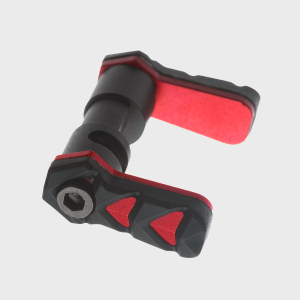
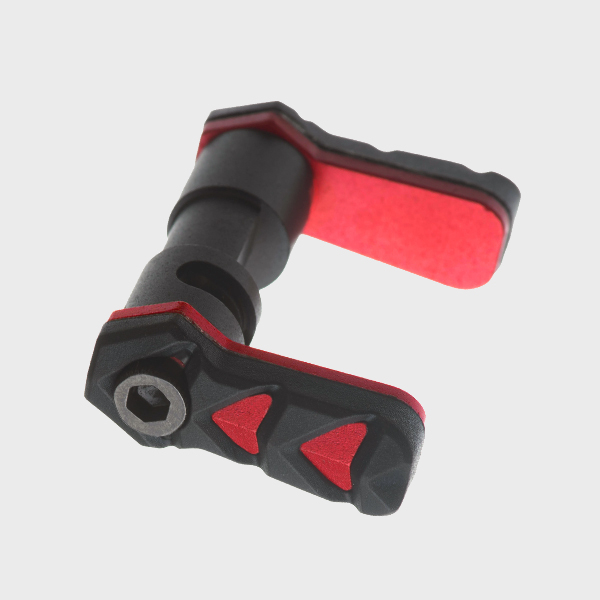
Many aftermarket AR-15 selectors provide controls on both sides of the receiver. This can improve accessibility for left-handed shooters and provide additional manipulation options for right-handed users.
Lever Size on Each Side
An ambidextrous selector does not necessarily need identical levers on both sides. Some shooters prefer a larger primary lever and a shorter secondary lever to reduce contact with the trigger finger.
Watch for Unwanted Finger Contact
A long lever on the opposite side of the receiver can rub against the shooter's hand or trigger finger depending on grip position. Lever geometry should therefore be considered alongside throw angle.
Modularity Can Be Valuable
Selectors that allow different lever configurations give shooters more freedom to adjust the control around their individual hand size and shooting technique.
Receiver Compatibility Matters With Short-Throw Selectors
Before purchasing a 45-degree selector, verify that the selector is designed to work properly with your specific lower receiver and fire-control configuration. Short-throw selectors should never be treated as universally interchangeable simply because they physically resemble standard AR components.
Follow Manufacturer Fitment Requirements
Use the selector only with configurations specifically identified as compatible by the manufacturer. This is particularly important because the safety is a functional control rather than a purely cosmetic accessory.
Verify Proper Operation After Installation
Any safety-selector change should be followed by the manufacturer's prescribed function checks before the rifle is used. If operation does not feel correct or the selector does not engage positively, the issue should be addressed before use.
Which Selector Is Better for a Carry or Defensive Rifle?
For a defensive-oriented AR, consistency and reliable operation should take priority over choosing a selector simply because it has a shorter throw.
A 45-degree selector may be attractive when it provides better ergonomics for the individual shooter. A 90-degree selector may make more sense when familiarity and consistency with other rifles are more important.
Consistency Across Rifles
If you regularly use several AR-15s, having dramatically different selector configurations can require additional familiarization. Some owners therefore standardize their controls across multiple rifles.
Choose What You Can Operate Naturally
The best selector should allow deliberate manipulation without forcing unnecessary changes to the firing-hand position.
Which Selector Is Better for Range and Competition Builds?
Range and competition-oriented rifles often provide more freedom to experiment with control geometry because concealment and standardized duty configurations may be less important.
Short-Throw Appeal
Shooters who value minimal control movement may prefer a 45-degree selector, particularly when combined with other ergonomic AR upgrades.
Personal Preference Still Matters
Even in performance-focused builds, a shorter throw only provides value when the shooter actually prefers its feel. A well-practiced 90-degree selector remains a perfectly viable configuration.
Don't Choose Based on Throw Angle Alone
Comparing 45-degree and 90-degree selectors purely by rotation distance misses several factors that determine how the control actually feels.
Look at Lever Geometry
A well-shaped lever can make a traditional selector easier to operate, while an uncomfortable lever can make even a short-throw design feel awkward.
Consider Surface Texture
Useful texture provides positive thumb contact without creating unnecessarily sharp or uncomfortable edges.
Think About the Complete Lower Receiver Setup
Your grip, receiver, trigger guard area, hand size, and selector all influence one another. Evaluating the control as part of the complete rifle produces a better result than selecting it in isolation.
45 Degree or 90 Degree: Which Should You Buy?
Choose a 45-degree selector if you prefer reduced thumb travel, compact control movement, and modern short-throw ergonomics. It can be particularly appealing when paired with a grip and hand position that make the traditional 90-degree sweep feel unnecessarily long.
Choose a 90-degree selector if you value traditional AR operation, already manipulate the standard selector comfortably, or want consistent controls across rifles that use conventional safety geometry.
Most importantly, choose a quality selector that is explicitly compatible with your rifle rather than making the decision based entirely on the advertised throw angle.
Did You Know?
Reducing selector throw from 90 degrees to 45 degrees cuts the required rotational movement roughly in half, but lever shape, grip position, and hand size can influence perceived ergonomics just as much as the throw angle itself.
Conclusion
The choice between a 45-degree and 90-degree AR-15 safety selector comes down to ergonomics, familiarity, and compatibility. A 45-degree selector provides shorter movement and can make manipulation feel more natural with modern grip positions, while a traditional 90-degree selector offers familiar operation and broad compatibility. Consider lever geometry, ambidextrous configuration, hand position, and your existing training habits before making the change. To explore control upgrades and other components for your rifle, visit Tyrant CNC AR-15 safety selectors.
FAQs
What is the difference between a 45-degree and 90-degree AR-15 safety selector?
The primary difference is the amount of rotation required between selector positions. A 45-degree design uses a shorter rotational path than the traditional 90-degree configuration.
Is a 45-degree safety selector better than a 90-degree selector?
Not universally. A 45-degree selector can provide more compact movement, while a 90-degree selector offers traditional operation. The better option depends on the shooter's ergonomics and preferences.
Will a 45-degree selector fit every AR-15 lower?
No. Compatibility should be confirmed with both the selector and lower receiver manufacturer before purchasing or installing a short-throw selector.
Is an ambidextrous safety selector worth considering?
It can be useful for both left- and right-handed shooters because it provides access from either side of the receiver. Lever dimensions should be selected carefully to avoid unwanted contact with the hand.
Should all of my AR-15s use the same selector angle?
They do not have to, but some shooters prefer consistent control layouts across multiple rifles because it keeps manipulation familiar from one setup to another.