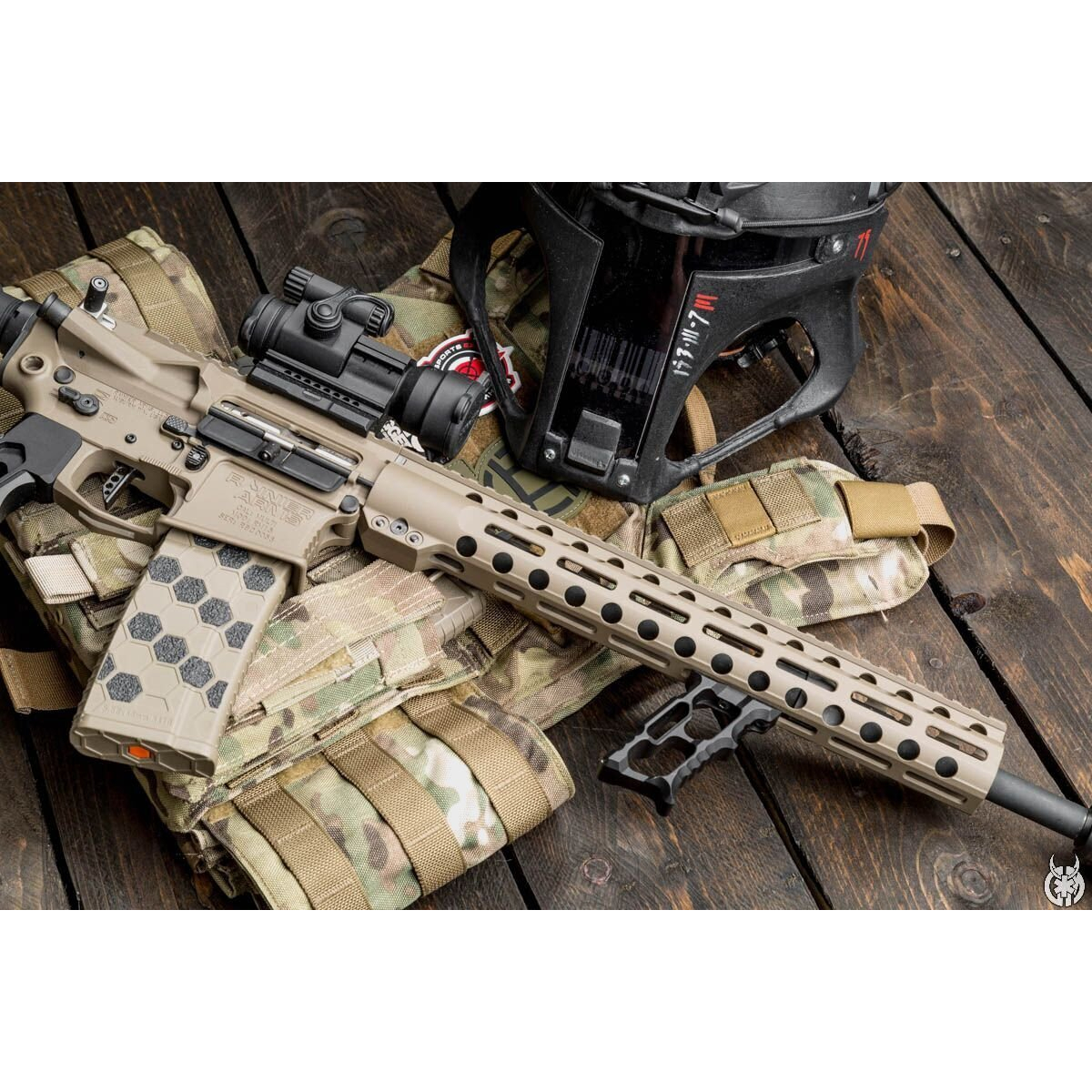
An AR-15 handguard affects much more than the appearance of the rifle. It determines how much usable mounting space is available, where the support hand naturally rests, how much weight sits toward the front of the rifle, and where sling hardware can be positioned. For buyers comparing modern handguards, M-LOK space, overall weight, handguard length, and sling attachment options should be evaluated together.
The best handguard is not automatically the longest rail or the model with the greatest number of attachment slots. A lightweight setup with carefully positioned accessories may benefit from a streamlined handguard, while a rifle carrying a light, hand stop, sling mount, and other equipment needs enough usable space to prevent those components from competing for the same locations. Choosing correctly starts with understanding how the complete setup will use the available rail.
Why the Handguard Has Such a Large Effect on an AR-15
The handguard is one of the largest components surrounding the front of the rifle, and even relatively small differences in dimensions or weight can change how the complete setup feels.
It Defines Support-Hand Space
Handguard length and profile determine how much room is available for different support-hand positions. A longer rail provides more usable surface, while a shorter design creates a more compact front end.
It Carries Many External Accessories
Modern M-LOK handguards can support compatible lights, hand stops, foregrips, sling attachments, and other accessories. The available mounting positions therefore influence how easily those components can be organized.
It Adds Weight Forward of the Receiver
Handguard weight matters because it is positioned toward the front of the rifle. The complete front-end setup should be considered rather than evaluating the bare handguard alone.
Start With Handguard Length
Length determines how much mounting space and gripping surface the handguard provides, but more length also means more material.
Shorter Handguards
A shorter handguard can reduce front-end dimensions and weight, but available space becomes more valuable because the support hand and accessories must share a smaller area.
Longer Handguards
A longer rail provides additional room to separate accessories and gives the support hand more possible positions. It can be useful when the build requires several mounted components.
Choose Length Around the Complete Configuration
Instead of buying the longest handguard available, determine how much usable surface the planned setup actually requires. Extra unused rail adds little value if the goal is keeping the rifle streamlined.
M-LOK Space Is More Important Than Total Handguard Length
Two handguards of similar length can provide very different amounts of usable accessory space. Slot placement and surrounding geometry matter just as much as overall dimensions.
Count Usable Positions
Look at where M-LOK slots are positioned along the sides and lower portion of the handguard. Some areas may be occupied by the support hand, sling hardware, or other components.
Consider Multiple Mounting Surfaces
M-LOK positions around different sides of the handguard provide more flexibility than placing every accessory along one surface.
Leave Space Between Functions
A setup becomes easier to organize when a hand stop, light mount, and sling attachment do not all compete for the same small section of rail.
Think About M-LOK Space as a Limited Resource
New buyers often see empty M-LOK slots and immediately start looking for accessories to fill them. A better strategy is to treat open space as useful.
Your Hand Needs Room Too
The support hand should have enough uninterrupted surface to establish a comfortable position. Filling every available slot can create unnecessary contact points.
Accessories Need Clearance
Even when two accessories technically fit into neighboring M-LOK positions, their housings or mounting hardware may interfere with each other.
Unused Slots Preserve Flexibility
Leaving some positions open makes it easier to adjust the rifle later without reorganizing the entire front end.
Where the M-LOK Slots Are Located Matters
Slot orientation influences which accessories can be positioned naturally around the handguard.
Side Positions
Side M-LOK space is commonly useful for accessories that need to remain accessible without occupying the bottom gripping surface.
Bottom Positions
The lower surface is often relevant for compatible hand stops and foregrips. Because the support hand interacts directly with this area, accessory size and placement should remain comfortable.
Upper Positions
Some handguards also provide additional mounting flexibility around the upper portion of the rail. Buyers should evaluate whether those positions serve their planned configuration rather than simply counting the total number of slots.
Handguard Weight Is Only Part of the Weight Equation
Manufacturers commonly list the weight of the handguard itself, but the finished front end can be considerably different after accessories are installed.
Start With the Bare Rail
A lighter handguard provides more flexibility to add necessary equipment without making the complete setup unnecessarily heavy.
Add the Mounting Hardware
Barrel nuts, mounting components, rail sections, covers, and accessory mounts all contribute to finished weight.
Then Consider Accessories
A light, hand stop, sling hardware, and other components can collectively add more weight than expected. Buyers should judge the complete configuration rather than comparing only bare-handguard specifications.
Where the Weight Sits Matters
An ounce added near the front of a long handguard can feel different from an ounce positioned closer to the receiver because the weight is farther from the shooter's body.
Front-Heavy Builds Feel Different
Adding multiple accessories near the muzzle end increases the amount of weight carried at the far end of the rifle.
Accessory Placement Can Improve Balance
Not every component needs to sit as far forward as physically possible. Positioning accessories according to actual reach and clearance requirements can help avoid unnecessary front-end concentration.
Lightweight Builds Require Discipline
Choosing a lightweight handguard has limited value if every empty M-LOK slot is later occupied by another accessory. The complete build should follow the same weight objective.
Longer Does Not Automatically Mean Better
Long handguards provide substantial accessory space, but buyers should consider whether they need that additional length.
More Surface for Hand Placement
A longer handguard provides more flexibility in where the support hand can rest, particularly for shooters who prefer a more forward hand position.
More Accessory Separation
Additional rail length makes it easier to separate the sling mount, hand stop, and other accessories instead of concentrating everything into a small area.
More Material
Additional length can increase overall dimensions and potentially weight. Buyers should make sure the extra space will actually be used.
Handguard Diameter Changes the Experience Too
Weight and length receive much of the attention, but cross-sectional shape and circumference directly affect how the rail feels in the support hand.
Slim Handguards
A narrower profile can be comfortable for shooters who prefer wrapping more of the hand around the rail.
Larger Profiles
A more substantial handguard may provide different heat-management characteristics and more physical structure, but it can feel oversized to shooters with smaller hands.
Accessories Increase Effective Diameter
Rail covers, switches, mounts, and other equipment can make a slim handguard feel considerably larger once the setup is complete.
Free-Float Handguards Offer a Flexible Accessory Platform
Modern free-float handguards are popular because they provide extensive mounting space without relying on traditional full-length accessory rails around every surface.
M-LOK Keeps Unused Areas Streamlined
Accessories can be installed only where they are needed, leaving the rest of the handguard relatively clean.
Support-Hand Position Is Less Restricted
Without continuous raised rail sections along every side, unused M-LOK surfaces can remain relatively low profile.
Accessory Planning Still Matters
Having many possible mounting locations does not mean every location should be occupied. The handguard should remain comfortable after the complete accessory package is installed.
Plan the Sling Before Filling the Rail
Sling attachment is often considered after the rest of the handguard has already been configured. Planning it earlier can prevent conflicts between the sling and other accessories.
Identify the Front Attachment Area
Determine where the front sling connection will sit before deciding where neighboring accessories belong.
Consider the Rear Attachment Too
The front mount works as part of a complete sling path. Rear attachment location influences how the sling runs alongside the rifle.
Keep the Sling Path Clear
The sling should not constantly fight against other mounted equipment. A clean path can reduce twisting and unnecessary contact with accessories.
Integrated QD Sockets Can Save M-LOK Space
A handguard with built-in quick-detach sling sockets can provide an important advantage because the sling does not necessarily require a separate M-LOK-mounted QD accessory.
More Slots Remain Available
Using an integrated socket can leave M-LOK space open for other compatible accessories or simply preserve a cleaner rail.
Fewer Added Components
An integrated attachment point reduces the need for another separate mount and its associated hardware.
Socket Location Still Matters
An integrated QD point is only useful if its location works with the intended sling routing. Buyers should examine where the sockets are positioned rather than simply checking whether they exist.
Multiple QD Points Provide Setup Flexibility
Several QD locations can allow the sling position to be changed without replacing hardware, but more sockets do not mean multiple attachment points should be active simultaneously.
Primary Sling Position
Choose the location that provides the cleanest routing for the normal configuration.
Alternative Positions
Additional sockets can provide options if accessories or preferences change later.
Avoid Unnecessary Sling Crossover
The sling should follow a simple path. Complicated routing around multiple mounts and accessories can create twisting and interference.
Side QD Placement Can Keep the Bottom Surface Clear
A side-mounted front sling connection can be useful when the lower M-LOK surface is already being used for a hand stop or when the shooter wants an uninterrupted lower gripping area.
Keep the Support-Hand Area Open
Moving sling hardware away from the bottom can preserve space around the natural support-hand position.
Watch Nearby Accessories
The sling should not repeatedly rub against other mounted components as the rifle moves.
Match the Front and Rear Sling Path
The front attachment should work with the rear mount so the sling follows a natural path instead of being forced around the rifle.
Hand Stops Can Preserve Valuable M-LOK Space
Buyers who want a physical indexing point for the support hand should consider how much rail space the accessory occupies.
Compact Designs Leave More Rail Open
A small hand stop can provide a defined reference point while occupying less mounting area than a larger forward accessory.
Position Around Natural Hand Placement
The accessory should complement the position where the support hand naturally rests rather than forcing the hand to move simply because a particular slot was available.
Leave Room for Future Adjustments
Keeping neighboring M-LOK positions open allows the hand stop to be repositioned if grip preferences change.
M-LOK Hardware Needs Proper Clearance
Accessory fit is not determined only by the external slot. The hardware behind the slot also needs enough room to seat correctly.
Screw Length Matters
M-LOK accessories should use hardware appropriate for the accessory and handguard. Hardware that is too short may not provide the intended engagement, while excessive length can create internal clearance problems.
Nut Position Matters
The M-LOK nut needs to rotate and seat correctly behind the slot so the accessory clamps against the handguard as designed.
Internal Clearance Can Vary
Gas-system components and the internal profile of the handguard can limit available clearance in certain locations. Buyers should not assume every visible slot provides identical internal space.
Anti-Rotation Features Are Worth Checking
A free-float handguard relies on its mounting system to remain aligned with the upper receiver. Buyers should examine how the rail is secured rather than focusing exclusively on M-LOK count and appearance.
Anti-Rotation Tabs Add Mechanical Support
Properly designed tabs interface around the upper receiver to help resist unwanted handguard rotation.
Mounting Hardware Matters
The barrel nut and handguard locking system are fundamental parts of the rail. A handguard with extensive accessory space is only useful when the mounting interface remains stable.
Top-Rail Alignment Should Be Consistent
The transition between the upper receiver and handguard should remain properly aligned when the system is installed according to manufacturer specifications.
Rail Covers Affect Usable Space and Grip Feel
M-LOK covers can change the texture and effective diameter of the handguard while protecting unused areas from direct hand contact.
Only Cover the Space You Need
Covering every slot may add unnecessary material and can make later accessory changes more inconvenient.
Prioritize the Support-Hand Area
Rail covers are most relevant where the hand regularly contacts the handguard.
Removable Covers Preserve Flexibility
A modular cover system allows selected sections to be opened when another accessory is added without changing the entire handguard setup.
Heat Management Should Be Part of the Buying Decision
The handguard surrounds components that become hot during extended use, so material, ventilation, profile, and gripping surfaces all influence comfort.
Material Conducts Heat Differently
Aluminum handguards provide strength with relatively low weight, but the way the gripping surface is designed can affect how heat is perceived by the support hand.
Rail Covers Can Change Hand Contact
Compatible covers create an additional surface between the hand and exposed handguard material.
Accessory Density Can Affect Available Grip Areas
A crowded handguard gives the shooter fewer options to reposition the support hand. Keeping some surfaces open preserves flexibility during longer range sessions.
Do Not Choose a Handguard Based on Appearance Alone
The handguard is visually prominent, making appearance an understandable consideration, but dimensions and accessory layout have a much larger effect on everyday usability.
Start With Required M-LOK Space
Determine how much mounting area the planned accessories actually need.
Then Compare Weight
Look at how much weight the handguard contributes before adding the planned accessories and mounts.
Finally Evaluate Sling Options
Make sure the rail provides a clean way to position the front sling attachment without sacrificing the M-LOK locations needed elsewhere.
Lightweight Builds Need a Different Handguard Strategy
If low weight is the main objective, every front-end component should support that goal.
Avoid Unused Length
Choose enough handguard to provide the required grip and mounting space without adding substantial unused material.
Use Compact Accessories
Small hand stops and integrated sling attachment points can reduce the number of separate components attached to the rail.
Track the Complete Front-End Weight
The bare handguard specification is only the starting point. Consider rail covers, mounting hardware, sling hardware, and other accessories together.
Accessory-Heavy Builds Need More Space Planning
A rifle with several handguard-mounted components benefits from more careful layout before the rail is purchased.
Map the Support Hand First
Reserve the area needed for comfortable hand placement before assigning locations to accessories.
Reserve the Sling Path
Choose a front QD position that does not interfere with the support hand or neighboring equipment.
Keep Some Adjustment Range
A handguard with additional usable slots gives the owner room to reposition components later without replacing the entire rail.
What to Check Before Buying an AR-15 Handguard
A good buying decision comes from evaluating the handguard as the foundation for the complete front-end configuration.
Length
Choose enough length for the intended support-hand position and accessories without adding unnecessary material.
M-LOK Layout
Check where the slots are located, not simply how many the handguard has.
Weight
Consider both the listed handguard weight and the weight of the accessories that will eventually be mounted to it.
QD Sling Locations
Determine whether integrated QD sockets are provided and whether their positions match the planned sling path.
Mounting System
Review the barrel nut, locking mechanism, and anti-rotation features provided by the design.
Grip Profile
Make sure the handguard circumference and surface treatment suit the shooter's hand size and preferred support-hand position.
A Simple Handguard Selection Strategy
Instead of starting with a specific appearance, buyers can narrow the options by answering a few practical questions about the finished setup.
First: Determine Hand Position
Establish approximately how much forward gripping surface is comfortable. This creates a useful baseline for handguard length.
Second: Map the M-LOK Accessories
Identify which mounting surfaces are needed and leave sufficient open space around the support hand.
Third: Choose the Sling Location
Decide where the front sling attachment should sit and whether an integrated QD socket can preserve valuable M-LOK space.
Fourth: Evaluate Finished Weight
Add the expected accessory package mentally to the handguard rather than comparing bare rails in isolation. This provides a more realistic picture of the final balance.
Did You Know?
The Tyrant CNC NexGen 15-inch AR handguard combines M-LOK mounting positions with four integrated QD locations, allowing sling placement to be planned without automatically dedicating a separate M-LOK slot to a QD mount.
Conclusion
An AR-15 handguard should be selected around the complete front-end setup rather than length or appearance alone. Start by determining how much gripping surface you need, then map the M-LOK space required for the accessories that actually belong on the build. Compare finished weight instead of focusing only on the bare rail, and plan the sling attachment before other components occupy the available mounting positions. Integrated QD locations, a stable mounting system, useful M-LOK placement, and a comfortable grip profile can make a handguard much easier to configure without unnecessary clutter. To explore an AR platform category built around these considerations, visit Tyrant CNC AR-15 Upgrades.
FAQs
How much M-LOK space does an AR-15 handguard need?
There is no single ideal amount. The handguard needs enough usable space for the intended accessories while preserving a comfortable support-hand area and room for future adjustment.
Is a longer AR-15 handguard always better?
No. A longer handguard provides more gripping and accessory space, but it also adds dimensions and potentially weight. Choose length according to actual hand position and accessory requirements.
Why are integrated QD sling mounts useful on a handguard?
Integrated QD sockets can provide sling attachment options without requiring a separate M-LOK QD mount, leaving more slots available and reducing the number of added components.
Should handguard weight include accessories when comparing setups?
Yes. Bare-handguard weight is useful for initial comparison, but the finished front-end weight also includes mounting hardware, rail covers, sling hardware, hand stops, and other installed accessories.
What should I check before buying an M-LOK handguard?
Check overall length, usable M-LOK locations, weight, grip profile, QD sling options, mounting hardware, anti-rotation features, and whether the layout provides enough clearance for the accessories planned for the finished rifle.