Hearing protection should be pretty standard equipment for virtually every single shooting situation. While some sensible compromises can be made for suppressed shooting and hunting, hearing protection should be a serious consideration in most situations involving anything louder than background conversation or television noise. Shooting-specific hearing protection has been around for decades and has come a long way in terms of technology and features, but the goal is still the same - to muffle the report of firearms to a point where instant hearing damage doesn’t occur. Today we’ll discuss what hearing protection I consider best for certain situations and some brands and methods I’d recommend for keeping your ears safe no matter what kind of shooting you’re into.
Over The Ear
First off we’ll talk about over-the-ear hearing protection. Also called ear muffs, or headsets, over-the-ear hearing protection is by far the most effective type of hearing protection and it’s entirely due to the method by which ear muffs block loud noises. Sound is just pressure waves moving through the air. Everything including the skin, cartilage, and bones surrounding your ear is vibrated by these noises and particularly loud noises can still do damage even if you plug your ear canal. Earmuffs not only cover your ear canal and muffle sounds going directly into your ear, but they also provide your temporal bone with some much-needed protection as your temporal bone can directly transmit sound waves that impact it.
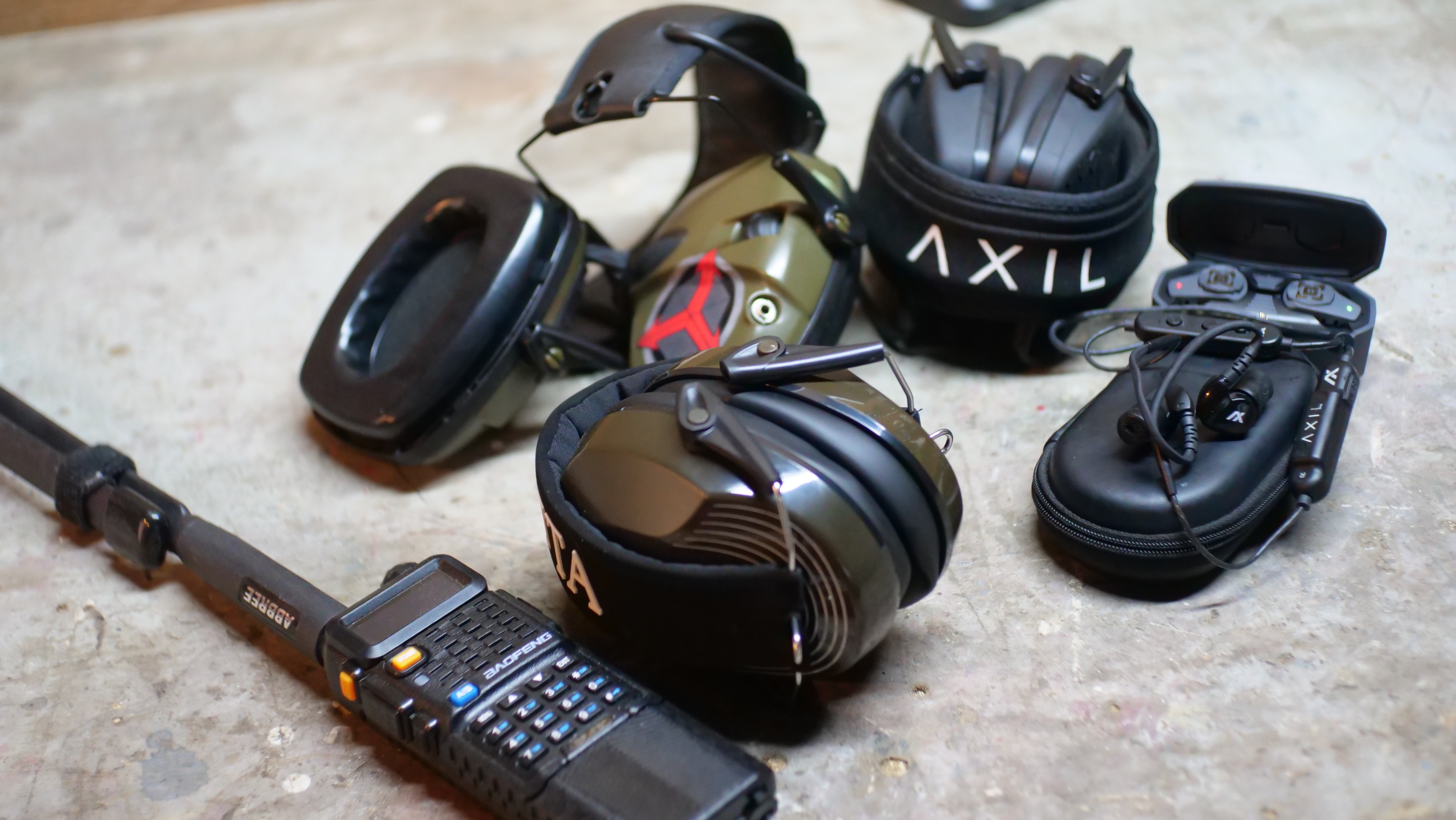
For over-the-ear muffs, I would first recommend Peltor Comtacs. Considered to be the best in the business by both civilians and military operators. Peltor comtacs provide lots of adjustment and aftermarket options for a well-rounded shooter including different ear cup designs, comms capabilities, and different types and styles of headbands including direct attachment to bump helmets. The downside with the Peltor Comtacs is that they’re quite expensive, about $500, and for the casual or occasional shooter, this might be too much. Another pair I can solidly recommend are the tried and true Howard Leight Impact Sports muffs. These were my first pair of big boy earmuffs and they’re not only super affordable, they’re still capable of being used with radios in a limited way and they do have some aftermarket support as well - they’re just not as durable, long-lasting, or flexible as the Comtacs.
Even with over-the-ear hearing protection, you might want to double up with a spare seat of plain foam hearing protection in addition to your muffs, especially when you shoot indoors or are shooting a high volume of rifle and or unsuppressed magnum rifle in a confined space. Many ranges have awnings over the shooting positions which redirect a lot of the noise directly back at you and in these types of situations is always a safe bet to double up on hearing protection just to be sure you’re not damaging your ears.
In Ears
In-ear hearing protection isn’t quite as effective at mitigating sound as over-the-ear, but they have a couple of distinct advantages. For one, in-ear are always going to be lighter and will work better with your wardrobe. For people who wear hats, or helmets, or are moving around athletically during shooting, in-ear hearing protection gives you a good compromise between hearing protection against loud sharp noises, as well as providing you with more mobility over earmuffs. In addition to the mobility increase, in-ear hearing protection is also a lot less prone to making your ears sweat on hot range days - it’s for this reason that I primarily use a pair of AXIL Ghost Stryke 2.0 electronic in-ear hearing protection.
My top recommendation therefore is of course the Ghost Stryke 2.0s from AXIL. While they’re not the most expensive, most durable, or even the longest-lasting in-ear hearing protection out there, they are often on sale and they have great foam earpieces that stay put. Best of all they’re also extremely lightweight and will last several days if you don’t need the Bluetooth connectivity and leave that feature turned off. For a more robust and even more streamlined option, the Otto Noizebarrier Micros have just as good if not better hearing protection but are even lighter and don’t feature the cable connecting the two earpieces. The downside with these is that they’re much easier to lose and more expensive. They do however come in a convenient charging case.
In-ear hearing protection is my preferred option when I’m shooting competitions, hunting, and when I’m shooting suppressed rifles with supersonic ammunition. In these situations, I’m either optimizing for less bulk, or only counting on making one or two shots, and therefore the added protection that over-the-ears provide is less important. If you’re only planning on shooting rimfire, or handguns, in-ear can be a great option to cut down on the bulk and heat buildup you get from muffs which can do a lot to make your range day more pleasant.
Be Smart - Don’t Blow Out Your Ears
There is no “one size fits all” solution for hearing protection unless you’re willing to double up and shoot suppressed with subsonic ammunition every single time. Guns by their very nature are just loud and it’s up to us as shooters to cautiously and consistently select the ear protection that will be the most effective for each given situation. That’s typically why while I’ll always have my in-ears go on first, I’ll always have a backup pair of over-the-ear hearing protection just in case I find something particularly loud to shoot that day. Of course, we’d like to hear what you guys wear at the range. What’s your go-to hearing protection and why? What are some of your favorite brands of earmuffs and earbuds when you get new pairs? We’d love to hear from you!