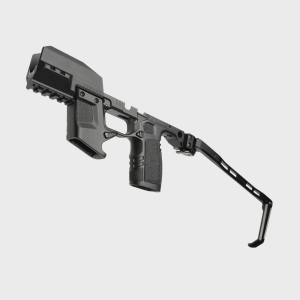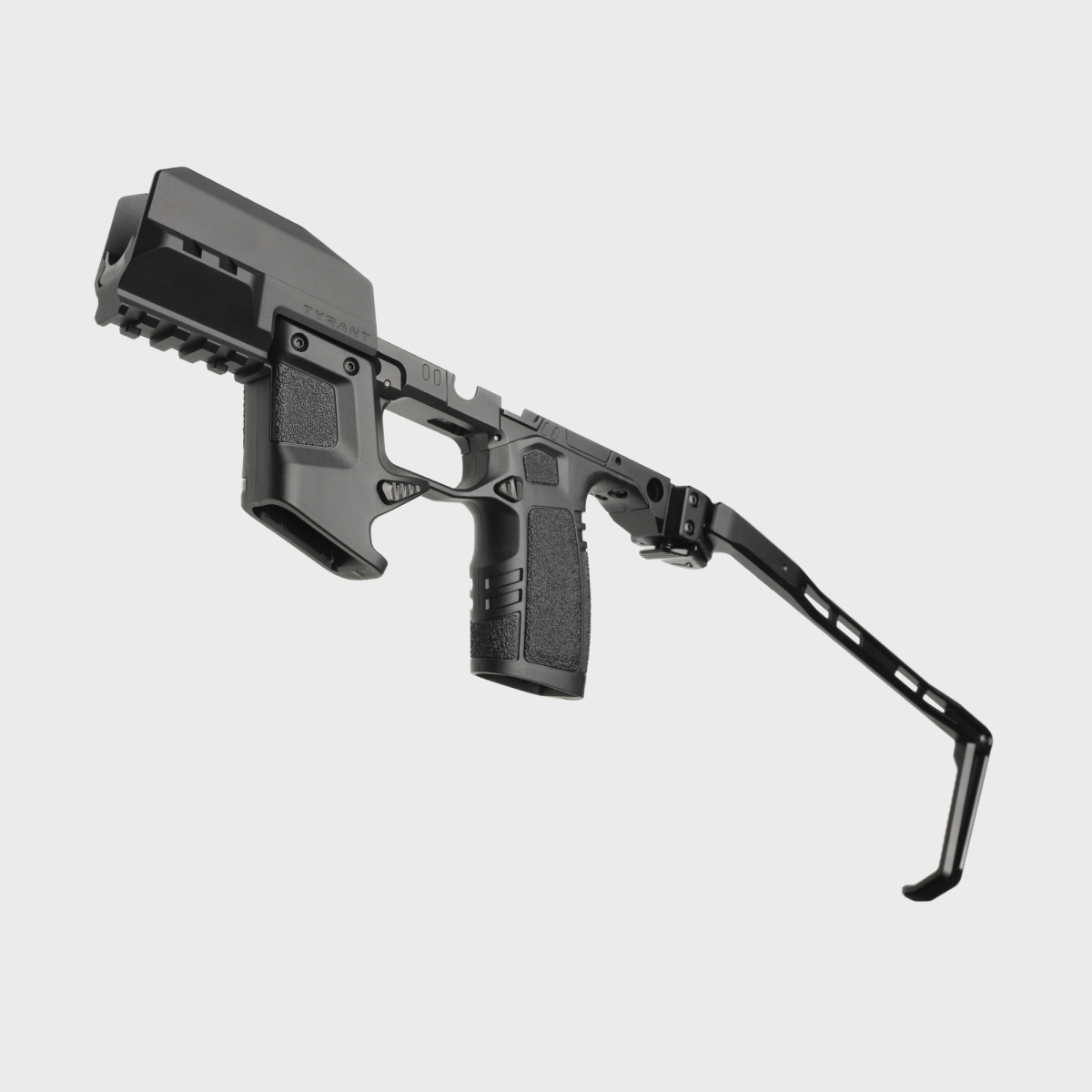
The Tyrant Weapon System 365 and Flux Raider 365 approach the same basic concept from different directions: take the modular SIG Sauer P365 platform and place it into a compact PDW-style chassis that provides additional stability, accessory capability, and onboard magazine storage. For P365 owners interested in this category, the comparison naturally comes down to fitment, construction, brace design, optic configuration, modularity, and which existing P365 components can be retained.
Although the two systems may appear similar at first glance, they are not interchangeable versions of the same design. The TWS365 emphasizes broad P365 configuration flexibility through a hybrid aluminum and polymer chassis, while the Raider 365 has its own compatibility requirements and accessory ecosystem. Understanding these differences is important before choosing a platform around an existing P365.
The Biggest Difference Starts With P365 Fitment
If you already own a P365, slide compatibility should be one of the first things you compare. Your existing configuration may have a significant influence on which chassis makes more sense.
TWS365 Configuration Flexibility
The TWS365 was developed as a modular chassis around the P365 platform. Its open upper design provides flexibility for different P365 slide, barrel, muzzle device, and optic configurations rather than requiring the pistol to conform to one enclosed upper arrangement.
Raider 365 Slide Requirements
The Raider 365 is designed around 9mm P365 components but has more specific upper requirements. XL-length and longer slides are supported, including configurations such as the P365 XL, XMacro, and Spectre Comp.
Standard-length P365 slides are not the ideal direct configuration for the Raider 365 and may require a different barrel arrangement. That distinction can be particularly important for buyers hoping to reuse a smaller P365 upper.
Construction Philosophy Is Different
The materials and architecture used for the chassis are another major point of separation.
TWS365 Hybrid Construction
The TWS365 combines an aluminum receiver structure with a polymer grip. This hybrid approach is intended to provide rigidity in the central chassis while keeping the complete system relatively lightweight.
Why Construction Matters
A chassis becomes the interface between the FCU, grip, upper assembly, brace, and accessories. Buyers should therefore consider construction as part of the complete system rather than looking only at external appearance.
Brace Design and Storage
Compact storage is one of the main reasons buyers consider a P365-based PDW chassis in the first place. Both systems address this requirement with folding brace configurations, but their designs and surrounding chassis architecture differ.
TWS365 Spring-Loaded Folding Brace
The TWS365 uses a spring-loaded side-folding brace attached through its rear interface. When folded, the brace keeps the overall package significantly shorter for transport and storage.
Consider the Complete Folded Package
Buyers should look beyond brace length alone. Optics, muzzle devices, weapon lights, magazine configuration, and other accessories can influence the final stored dimensions of either system.
Both Systems Approach Spare Magazine Storage Differently
One of the defining features of this PDW category is the ability to carry a spare magazine directly on the chassis.
TWS365 Dual-Magazine Concept
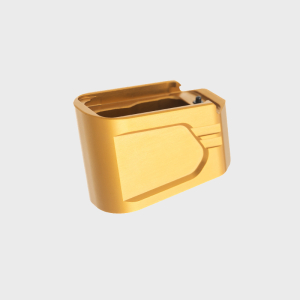
The TWS365 incorporates a removable forward magazine holder into the chassis. This allows the system to carry the magazine inserted into the pistol plus a second magazine at the front of the platform.
Why Onboard Capacity Appeals to Buyers
Keeping a spare magazine attached to the system creates a self-contained package. Rather than treating the firearm and spare magazine as separate equipment, the chassis keeps both together for storage and transport.
Optic Placement Is an Important Difference
Optic configuration is one of the most meaningful distinctions between different P365 PDW systems because it affects both modularity and the overall shooting interface.
TWS365 Retains the Slide-Mounted Optic Approach
The open upper architecture of the TWS365 allows the P365 slide to remain exposed. An optic installed on an optics-ready P365 slide therefore remains part of the reciprocating slide assembly.
Raider 365 Accessory Ecosystem
The Raider ecosystem provides options for chassis-mounted optic configurations. A non-reciprocating optic remains stationary as the slide cycles, which creates a different sighting arrangement from an optic mounted directly to the P365 slide.
Which Approach Is Better?
That depends on what the buyer values. Keeping an existing slide-mounted optic can simplify the transition from a conventional P365 configuration, while a chassis-mounted optic offers a different PDW-style setup.
Muzzle Device Flexibility Can Influence the Decision
P365 owners frequently customize their pistols with different barrels, compensators, and other muzzle configurations. Chassis geometry can determine how much flexibility remains after conversion.
TWS365 Open Upper Architecture
The TWS365 uses a removable aluminum blast shield while maintaining an open slide configuration. This architecture is particularly relevant to shooters who want greater flexibility when selecting the P365 upper assembly.
Build Around the Upper You Actually Own
Instead of choosing a chassis first and changing multiple existing components afterward, compare the chassis requirements with your current slide, barrel, optic, and muzzle configuration.
Accessory Mounting and Modularity
A PDW chassis becomes much more useful when accessories can be configured around the owner's intended setup.
TWS365 Accessory Interfaces
The TWS365 incorporates Picatinny interfaces for compatible accessories and uses a removable blast shield and magazine holder. This allows owners to configure the chassis without treating every component as permanently fixed.
Raider 365 Ecosystem
The Raider platform also offers a developing selection of dedicated accessories, including options that alter optic mounting, brace or stock configuration, and other aspects of the chassis.
Buyers who enjoy extensively configuring a PDW should compare not only what comes with each chassis but also what accessories are available for the platform they intend to build over time.
What About Existing P365 Components?
The ability to reuse parts you already own can substantially change the practical cost and convenience of either system.
Start With the FCU
Both systems are built around the modular nature of the P365 family. The removable P365 Fire Control Unit is what makes it possible to move the core firearm into a different chassis architecture.
Then Check the Upper Assembly
The bigger compatibility question is usually the slide and barrel combination. This is where differences between the TWS365 and Raider 365 become more important.
Don't Assume Every P365 Part Transfers
P365 is a family of pistols rather than one universal configuration. Standard P365, XL, XMacro, Fuse, compensated models, and aftermarket builds can differ significantly. Buyers should confirm their exact configuration before choosing either chassis.
Who Should Consider the TWS365?
The TWS365 is particularly interesting for P365 owners who value configuration flexibility. Its open architecture, hybrid chassis construction, folding brace, removable forward magazine holder, and accessory interfaces create a system designed around modularity.
It can also make sense for someone who wants to preserve more of the characteristics of an existing P365 upper rather than building the pistol around a more restrictive chassis configuration.
Who Might Prefer the Raider 365?
The Raider 365 may appeal to buyers who already have a compatible XL-length or longer P365 upper and want access to the established Flux-style PDW ecosystem.
Its dedicated accessory options and ability to support chassis-oriented configurations can be attractive to shooters who want to build around the Raider concept from the beginning rather than preserve as much of their conventional P365 setup as possible.
Compare the Complete Build, Not Just the Chassis
Looking only at the chassis can make the buying decision unnecessarily confusing. Instead, consider what the completed system will require.
If one option lets you retain your existing slide, barrel, optic, magazines, and accessories while another requires replacing several components, the total build can look very different. The opposite can also be true if you already own parts optimized for the other platform.
Think About Future Upgrades
Consider whether you expect to change optics, slides, barrels, muzzle devices, lights, or other accessories later. The chassis that best accommodates your future configuration may provide more value than the one that simply fits today's setup.
Did You Know?
The standard-length P365 upper is one of the most important differences to investigate when comparing these systems. The TWS365's open architecture provides greater flexibility around different P365 upper configurations, while the Raider 365 is primarily designed around XL-length and longer slides.
Conclusion
The TWS365 and Flux Raider 365 both expand what can be done with the modular SIG Sauer P365, but they are designed around different priorities. The TWS365 emphasizes an open, modular architecture with hybrid aluminum and polymer construction, a spring-loaded folding brace, onboard spare-magazine storage, and flexibility around P365 upper configurations. The Raider 365 offers its own established PDW architecture and accessory ecosystem but places different requirements on compatible P365 configurations. Before choosing either system, compare your exact FCU, slide, barrel, optic, magazines, and future upgrade plans. To explore the Tyrant platform and available configurations, visit Tyrant Weapon Systems for SIG Sauer.
FAQs
What is the biggest difference between the TWS365 and Flux Raider 365?
One of the most important differences is upper compatibility and chassis architecture. The TWS365 emphasizes flexibility around different P365 configurations, while the Raider 365 is designed primarily around XL-length and longer P365 slides.
Can the TWS365 use a standard P365 slide?
The TWS365's open upper architecture is designed to accommodate a broader range of P365 upper configurations, making existing slide and barrel setup an important advantage to consider when comparing the two systems.
Does the Raider 365 work with every P365 slide?
No. Standard-length P365 slides are not the recommended direct configuration. The Raider 365 is designed around XL-length and longer slides, including compatible XMacro and similar configurations.
Does the TWS365 carry a spare magazine on the chassis?
Yes. The system incorporates a removable forward magazine holder, allowing a spare compatible magazine to be stored directly on the platform.
Which system is better for P365 owners who frequently change configurations?
The TWS365 can be particularly attractive when flexibility around different P365 upper configurations, muzzle setups, and modular accessories is a priority. The best choice still depends on the exact P365 components you already own and how you intend to configure the finished system.